U.S. Pointer Study: Lifestyle Choices and Brain Health

We all know that eating right and exercising is essential to a healthy body, but did you know that it makes a big difference in your brain health too? The Alzheimer’s Association’s U.S. Study to Protect Brain Health Through Lifestyle Intervention to Reduce Risk (U.S. Pointer) was conducted to assess the effects of nutrition, movement, and cognitive challenges on brain health in older individuals. The main idea: to see if specific “interventions” could protect the brain and even reduce the risk of dementia.

So here’s the skinny on the study. In six locations across the U.S., 2111 people between the ages of 60 and 79 who had an increased risk of dementia due to family history, high blood pressure, cholesterol, or blood sugar and who did not exercise regularly volunteered for the 2-year study. They were divided into two intervention groups: structured and self-guided. Both groups engaged in physical exercise, computer-based brain challenges, nutritional changes, and were encouraged to participate in social activities – the difference being “structure, intensity, and accountability”. The structured group was given a very specific program for exercise, mainly a mix of strength training and aerobic activity, another for nutrition (the MIND diet), cognitive challenges via Brain HQ, and regular health checkups. They also met with staff 38 times over the course of the study to set goals and discuss progress. The self-guided group was encouraged to follow the same guidelines as the structured group, and had access to the same tools, however they ultimately chose the changes that fit in with their lives and schedules. They had support from the staff though they set their own goals, and participated in team meetings just 6 times during those 2 years to discuss their progress.

The results? All good! Both groups did well with 89% of participants completing the entire study. The self-guided group averaged better attendance at team meetings, which I thought was interesting. (Personally, I think 6 meetings is not quite enough, but knowing myself, I probably wouldn’t have attended all 38 meetings either.) The structured group did a great job of nearly meeting the “active minutes” goal of 90 minutes each week and surpassed the MIND diet goal of 9.5 by reaching a score of 11. Both groups were given health and brain checkups every 6 months throughout the study (which included cognitive tests and lab work) and the good news is that there was improvement “regardless of sex, ethnicity, genetic risk (ApoE4), or heart health status.” While both groups showed improved cognitive function, the structured group had a significantly greater improvement overall. The bottom line? Making healthier choices regarding exercise and nutrition, coupled with cognitive stimulation, make a big impact on brain health. And they’re not done. 83% of the participants are going to continue with a 4-year extension of the program to assess the long-term effects of lifestyle changes on cognitive function.

So what’s the secret? What’s the magic mix? Here’s the “Brain Health Recipe”:

  • Complete 30-35 minutes of moderate-to-intense cardio 4 times per week plus strength training and flexibility 2 times per week.
  • Engage in 30 minutes of computer-based brain challenges 3 times per week along with social and intellectual activities.
  • Follow the MIND diet (Mediterranean-DASH Intervention for Neurodegenerative Delay) which consists of fresh foods, preferably as unprocessed as possible, like dark leafy greens, berries, nuts, whole grains, fish, and olive oil with limits on sugar and “bad” fats like trans- and saturated fats.

That’s it. Exercise. Good food. Brain games. And if this “recipe” has worked for individuals at risk of dementia, think about what it could do for us all. Remember, change doesn’t have to be a total 180 . . . little changes over time are the stepping stones of better health later. Start with something simple: an extra serving of fruit or veggies each day, an extra glass of water, a few extra laps around the house, a quick crossword, sudoku, or other game that gets you thinking – whatever you like. Make it fun. The more you enjoy it the more likely you are to stick with it. I’m going to keep my eye out for more information and results, especially regarding the extension, and I’ll report back when I can. Until then, here’s to your (brain) health!

I hope you have a wonderful day!

https://uspointer.net/home.cfm

https://www.alz.org/us-pointer/home.asp

The information provided on this website is intended for educational purposes only and is, in no way, a substitute for professional medical advice. The events, practices, and opinions discussed here are those of the author and should be treated as such. ALWAYS talk with your doctor about conditions, medications, and concerns you have about your health and work together to determine the best course of action for you.

Woods Walk #3

Mission #3 is in the books! We’re taking care of my sister-in-law’s dog, Fred, for a few days and decided to bring him along to O’Hara Woods in Romeoville. And I have to say – looks can be deceiving.

First of all, the start of the walk wasn’t how we’d pictured it. In fact, our first attempt was a bust because we started at the complete opposite side of the preserve, off of Beverly Griffin. The true trailhead seems almost urban – it starts near the Police Department and Village Hall buildings, on Grande Blvd. We parked in front of the police department, then headed toward the residential area and picked up the paved path there.

Once we began to follow it around the building the landscape morphed into vast greenery, spreading behind the buildings and beyond. We paused at the fork. To the right, the path lead to the pavilion and the park. We turned left and within a few steps we were swallowed up in the forest.

From there, it was like we’d stepped into another world. We saw a few houses through the trees and an open area with a retention pond, but the rest was completely wooded. Birds everywhere. Squirrels darting from tree to tree. It was quiet. It was cool and peaceful. The paved path eventually turned into packed dirt that meandered through the woods. We followed an old wooden bridge that lead deeper into the forest and eventually to an open area.

Here is where our journey ended. We checked in at the Goosechase checkpoint, and contemplated going further but poor Freddie looked like he didn’t have much left in the tank. Besides, the path from there was grassy and grown over. We weren’t really comfortable taking him through so we turned back.

It wasn’t what we expected, for sure, but it really was a pleasant surprise. And now that we know where we’re going, we’ll probably head back again – maybe once the trees turn. It’s definitely worth a visit. A nice, quiet walk in the woods.

Happy hiking!

#OHaraWoods

#WoodsWalk2025

Woods Walks 1 & 2

With such beautiful weather this past weekend, Hubby and I decided to hit the Woods Walk trails and knocked out two of them: one on Saturday and the other on Sunday.

On Saturday, we hopped over to the Lake Renwick Heron Rookery: Heron Rookery Trail and Turtle Lake Loop. Turtle Lake is one of our favorite haunts – has been for years – but the trailhead for the challenge is off of Renwick Rd. in Plainfield, not Lockport St. The walk is about 2.5 miles total and offers cool views of the lakes plus the heron “apartments”. The rookery portion of the trail is closed during breeding season, usually early March through mid-August so it was nice to be able to meander along and look at the lake. We didn’t see any herons, unfortunately, but there were a few wading birds at Turtle Lake. For those who are looking for a fairly easy hike, this one’s for you. The rookery trail is crushed limestone and the Turtle Lake Loop is paved with a slight elevation. My selfie is at the trailhead . . . should’ve taken it before we worked up a sweat! Eek!

On Sunday we decided to visit Hammel Woods: DuPage River Trail. Make sure you check your map before you go. You’ll need to enter the preserve from Rte. 59, then follow the narrow winding road all the way down to the kayak launch. (You’re there when you reach the small circle drive and see the wooden bridge.) We really like this trail because of all the tree cover and it’s especially beautiful a bit later in the season when the leaves have changed. (I have some awesome pictures from a couple of years ago!) You can also veer off a bit and stand on the bank of the DuPage River and be soothed by the sound of the water. Further along the trail, at the Goosechase check-in, we were surprised to see that part of the trail was closed due to renovations or construction of some kind so it tells you to turn around. On their map it says it’s about a 2.5 mile trek, however MapMyRun gave us a total of about 3. Either way it’s a beautiful way to spend an afternoon and this path is completely paved as well – great for strollers, pets, and those who just like want to enjoy non-strenuous exercise. I didn’t take a picture of this one. One goofy selfie is enough . . .

Not sure where we’re going next but you can be sure I’ll report on it and give some tips and info in case you’d like to venture out for a walk.

Until then, happy hiking!

#reconnectwithnature

#WoodsWalk2025

Woods Walk 2025

It’s that time of year again – the weather cools, fall colors burst, the bonfire crackles, and the 23rd annual Woods Walk begins. I’m so excited!

For those who live in and near Will County Illinois, the Woods Walk offers a great opportunity to get outside, go hiking, and revel in the splendor of autumn. Every year the Will County Forest Preserve District selects several trails as part of a challenge, and those who complete it get a commemorative medallion; this year it features a fox.

Here’s the lowdown:

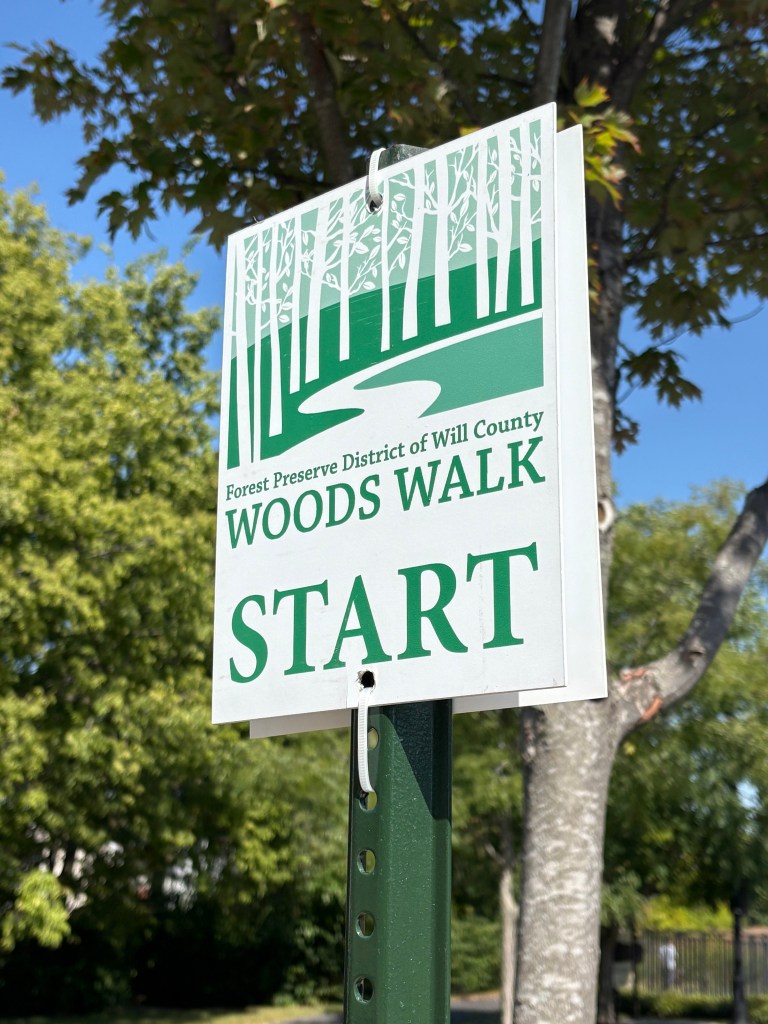
As always, make sure you’re prepared when you go hiking! Bring plenty of water, wear comfortable shoes or boots, and dress in layers. It’s fun to walk with friends and family, but if you choose to walk alone, please let someone know what you’re doing and where you’re going. Maybe even share your location. Keep an eye on the weather as well – this is Illinois, remember? It might be sunny now, but that could change in a heartbeat! Finally, look for the “Woods Walk Start” sign at the trailhead and HAVE FUN!!!

Note: Hubby and I were stoked to hit the O’Hara Woods trail this past weekend and couldn’t find the “Start”. Turns out we parked on the complete opposite side of the preserve and wandered around for about 45 minutes trying to find the trailhead! We got a great hike in, but didn’t get credit because we didn’t see the Goosechase checkin spot and were on the wrong side of the preserve. We’ll be going back for sure. We want that medallion! 🙂 If you’d like to hit this trail my suggestion would be to take Grand Blvd (off of 135th) toward the Romeoville Village Hall and Police Station. Park in the lot directly in front of the Police Station or (if it’s open) the lot just to the west.

Happy Hiking!!!

#reconnectwithnature

#WoodsWalk2025

Horiatiki Salad

Photo credit: Better Homes and Gardens Mediterranean Diet (2024 Edition)

Hubby and I are really enjoying our newly-adopted Mediterranean lifestyle. And I say ‘lifestyle’, NOT diet, because it truly is a way of life that includes other things, not just food. Combined with physical activity and emotional (or mental health) care, nutrition helps to create an overall sense of well-being and good health. Unprocessed food is great for us, filled with nutrients and flavor that feed our bodies; it can reduce inflammation, improve gut health, and prevent illness too.

One of our favorite go-to recipes (especially in a pinch!) is something that is so simple, yet so tasty, and takes very little time to prepare. It’s also incredibly adaptable. There’s no need for a scavenger hunt at out-of-the-way, expensive food markets that charge an arm and a leg for an ounce of product that’s been imported from some exotic land far, far away. You can find these things at your local farmer’s market or grocery store. It’s a Greek Village salad, a.k.a. Horiatiki. We found it in the Better Homes and Gardens 6th edition of the Mediterranean Diet magazine. We picked it up last year and have had lots of fun trying several recipes. Here’s the recipe:

Prep time: 15 minutes

Cook time: None

Servings: 6

6 oz. grape tomatoes, halved

1 medium bell pepper, diced

1/3 cup Kalamata olives, pitted

2 tablespoons extra virgin olive oil (EVOO)

1/2 teaspoon dried oregano

1 tablespoon capers (optional)

1 small cucumber, diced

1/2 med. red onion, thinly sliced

1 4oz. triangle feta cheese (or crumbles)

2 tablespoons red wine vinegar

1/2 teaspoon coarse sea salt

Place the tomatoes, cucumber, bell pepper, onion, and olives in a large bowl. We mix the EVOO, red wine vinegar, and oregano in a separate container then pour over the veggies and toss. Top with feta cheese and serve.

Note: We omit the salt. There are lots of flavors going on here and we don’t miss it. Also, neither of us is a fan of olives so we ditch those too, and we’ve had trouble finding capers, so we substitute sunflower kernels instead. Finally, to make this a one-dish meal, we add either sliced avocado or we use leftover grilled chicken and . . . voilá! Tasty. Filling. Healthy. And we usually have some extra for another night.

I hope you enjoy this recipe as much as we do. I’d love to hear how it goes for you or if you have any other substitutions. Enjoy!

The information provided on this website is intended for educational purposes only and is, in no way, a substitute for professional medical advice. The events, practices, and opinions discussed here are those of the author and should be treated as such. ALWAYS talk with your doctor about conditions, medications, and concerns you have about your health and work together to determine the best course of action for you.
Hello Again . . . and Again

I know, I know. It’s been quite a while since you’ve heard anything from me. It’s been quite a while since I’ve had a chance to breathe much less write. I’ve been working a lot, just like you, and there have been some rather large upheavals in my life that demanded my attention. For over a year. Crikey!

So here I am asking, once again, for your forgiveness for my lengthy absence.

True to my wanderlust nature, though, I’d be remiss if I didn’t reflect on the detour and hopefully learn some kind of lesson from the experience. Otherwise how would we grow, right?

Over the course of the last eighteen-ish months I’ve certainly learned that I can endure a lot. It was non-stop stress dealing with illness, death, elderly parents, work, and health issues. It seemed I was always going, doing, trying to help, all the while working and attempting not to ignore my husband and children. Once the dust settled a bit I was able to assess the damage. It wasn’t pretty. Lots of things around the house were neglected. Projects had gone unfinished. Things I wanted to do were put on the shelf – including this website. My body was feeling the effects of chronic stress – so much so that I became vitamin D deficient and needed a prescription for D2 for three months. Eek! Needless to say I was a little tired . . .

My husband felt the effects too and one day we finally sat down, looked at each other, and said, “We can’t keep this up for much longer.” So we made a plan, right then and there, to make some changes. We’ve adopted a more Mediterranean lifestyle which includes good, nutritious food and more activity. I made a choice to meditate every day. My husband is working on being at work fewer hours each day and severely limiting weekend work. I took up a new craft. We’ve begun to set a few boundaries. We’re also committed to spending more time together, even if it’s just talking or going for a walk. And at the end of our little powwow we wished each other a Happy New Day.

The results? Well, he’s lost about 10 pounds. I’ve lost about 7-8. My vitamin D level is back in the green – so is my energy!!! We’ve discovered some awesome recipes that don’t require tons of time or effort to make and we’re never hungry. 🙂 Hubby’s continuing to limit work time. I’m on a 74-day meditation streak. He’s learning to say ‘no’ at work a little more often. We love our 3.1 mile (5k) loop in our neighborhood. I’ve decided to open an Etsy store in the near future. Our stress levels are decreasing, which means we’re happier and more balanced. And we just booked a long weekend getaway in the fall.

Has it been easy? Nope. Have we faltered along the way? Yep! Did it happen overnight? No way. This has been three months in the making. LOL Has our plan needed tweaking? Uh huh. Has all of our stress disappeared? Absolutely not. The difference is that we’re forgiving ourselves for not being perfect, we’re making a concerted effort to change things which includes moving ourselves a bit higher on our priority list, and we’re beginning to see and feel results.

So now the time has come to begin again. To pursue that which lights my soul on fire and prompted me to change careers. Health. Wellness. In all its forms. I’m in the process of changing the look of the website, its focus, and the content. I have a few ideas churning in my brain so we’ll see how they pan out. It’s always a work in progress, isn’t it? As are we. But I suppose that’s just part of the journey . . .

See you soon!

“Beyond Weight Loss”: Part 5

Welcome to the final part of the “Beyond Weight Loss” series. The last article focused on changing our mindset and outlined Keith Klein’s 5 Steps to Self-Change. I hope you were able to begin to recognize where you are in your journey and that you’re armed with a bit more information that will help you move forward to the next step. Remember that revisiting a previous step is not a sign of failure, it’s just that you need to find what works for you. Please be patient with yourself as the path to Healthy is not easy. But it’s totally worth it.

Today I bring you a recap of the documentary as well as a few more pieces of advice from the experts. So far we’ve learned some great information about the secret of losing weight and the best ways to keep it off for good. We know to steer clear of fad diets that can make us fatter by actually slowing down our metabolisms and plunging our bodies into survival mode rather than revving them up into super-charged fat-burning machines. We also learned that eating well and staying hydrated are key ingredients of the process. That means incorporating the right amounts of protein, carbs, and fats as well as lots of good water in order to keep ourselves properly fueled every day. And of course we can’t forget to exercise, we just need to remember to do meaningful strength training plus cardio and mix those with flexibility training and fun activities that keep us moving. Finally, we must transform our way of thinking so that the changes we make will stay with us for the rest of our lives.

Throughout the documentary, the panel of experts offers up some words of wisdom that resonated with me. For example, Larry North tells his clients that success is made up of the “3 Ps: Persistence, Perseverance, and Passion.” If you stick with it, you will succeed, and it’ll become part of who you are and what you love to do. Dr. Roxanne Edrington mentions something particularly meaningful to me. She reminds us that our “why” is extremely important to our success. I speak from experience when I say that, while we may start our health journeys for many different reasons, if it’s not for the right reason(s), we’re setting ourselves up for failure from the very beginning. Definitely something worth chewing on . . .

Now, if you’re anything like me, every once in a while I crave something unhealthy. I tell my clients that I’m a sucker for pretzels, peanut M&Ms, and tiramisu. And sometimes I just have a hankering for a burger and fries. Or a little ice cream. Well, we know that depriving ourselves or trying to eat perfectly 100% of the time will only make us want it more and there we go, down that slippery slope once again. So what do we do when this happens? Keith Klein offers up a great nugget of assistance. He calls it the 3 steps of making “better bad choices”. I know. Whaaat? Here’s how it works. When those naughty nibblies are calling your name, you can:

  • make a more positive food selection. Keith says to try lower fat or lower calorie ice cream. Craving a chicken sandwich? Try the ‘grilled’ instead of the ‘crispy’. When you’re in a snacky mood, try air popped popcorn instead of potato chips.
  • cut back on the frequency. Instead of eating out twice per week, maybe just make it once every two weeks. You can also go get an ice cream cone every once in a while rather than buying the half gallons on sale and eating it every day.
  • cut back on the amount. In other words, don’t have as much or as many. Keith suggests eating an 8 ounce steak rather than a 12 ounce. I’m thinking maybe I could just eat 1 or 2 cookies instead of the whole batch.

This documentary really is a worthwhile investment of your time and consideration. There are so many things that we can take away from it that mean something to us – and that’s as it should be. We need to figure out what works for us. As individuals. Here are the main tips and tricks the experts suggest:

  1. Eat the correct foods. (Whole foods rather than processed)
  2. Eat the correct combination of foods. (Protein, fats, and carbs)
  3. Eat the correct portion size. (And preferably lower than 20% fat)
  4. Eat every 3 hours (About 5-6 small meals)
  5. Drink water (Half your body weight in ounces)
  6. Don’t let a lapse turn into a relapse (“Don’t slash the other 3 tires.”)
  7. Join a community (Accountability and fun factor)
  8. Make it a lifestyle change (Make sure it’s sustainable)
  9. Make sure to include weight training and cardio in your exercise routine (Do something you enjoy too)
  10. Cook and carry your food (Cuts down on eating out or on-the-go)

I sincerely hope you’ve gotten some interesting and useful information from these articles and that it moves you to watch “Beyond Weight Loss: Cracking the Fat Loss Code”, discovering the facts and advice that mean the most to you. But more than that, my wish for you is that it inspires you to take action regarding your health now and for the rest of your life. Until next time . . .

#personalgrowth

#BeyondWeightLoss

The information provided on this website is intended for educational purposes only and is, in no way, a substitute for professional medical advice. The events, practices, and opinions discussed here are those of the author and should be treated as such. ALWAYS talk with your doctor about conditions, medications, and concerns you have about your health and work together to determine the best course of action for you.

“Beyond Weight Loss”: Part 4

Welcome back! It is my sincere hope that you were able to pick one or two of the tips we learned in Part 3 and begin to apply it to your nutrition routine. I’m pretty well hydrated, I try to eat whole foods, and hubby and I prepare our meals, making enough for leftovers for another night when we’re short on time or so that we can take it with us for lunch. My challenge, now, is figuring out how to fit smaller meals into my day, which is turning out to be incredibly difficult since my schedule isn’t always the same every day. I don’t know if you have the same issue, but if so, I’ll let you know if I come up with anything that may help us . . .

Today I want to tackle more of the psychological aspect of losing weight. We all know we need to eat good food and exercise, however that is much easier said than done. It takes time and effort, for sure, but I feel that the underlying message of the whole documentary has more to do with changing our mindset first. So how do we do that? Keith Klein offers his 5 Steps to Self-Change:

  1. Awareness – This is the stage when we become incredibly aware that what we’ve been doing isn’t working any longer. It can be triggered by something someone says to us, the fact that our clothes don’t fit, seeing ourselves in a picture, a medical scare or condition, or any number of things. (This is my ‘slap in the face’ or the ‘holy s___’ phase.) Keith says that these external motivators are great for making us aware, however they aren’t quite enough to bring about change.
  2. Contemplation – This stage has us asking ourselves how we can institute and apply changes to our current lives. How will it fit into our social lives? How do we put the changes into action? This phase requires taking stock of our current situation and figuring out how to implement change. Keith says we can’t skip this step, but he warns us not to spend too much time here because it leads to procrastination. (This is my ‘analysis paralysis’ or ‘getting ready to get ready to get ready . . .’ phase.)
  3. Knowledge – This is a tricky phase. Of course we need to arm ourselves with information, however there are a couple of things to consider. First, there is no one-size-fits-all method for health. We need to find the right information for us, individually, about how to change. Second, we need to be careful of extremes and defective information that can derail our efforts and set us up for failure. (This is my ‘do I actually see myself doing this for the rest of my life?’ phase.)
  4. Action – Time to put your desires and research to the test. It’s time to “implement, experiment, and adjust” your plan. See what works and what doesn’t. Are your proposed changes sustainable? (This is my ‘cross it off the list’ or ‘tweak it’ phase.) Keith sends us a special message here: he says that if something doesn’t work, revisit Step 2, possibly Step 3, then advance to Step 4 again. We may do this several times until we find what works for us. He wants to make it clear, however, that going back to Step 2 does not equal failure. It simply means that we have more to learn and that we shouldn’t give up.
  5. Self-accountability – This is the final stage when all of your determination, research, and hard work pay off, you get results, and your new lifestyle becomes part of who you are. Keith describes it as intrinsic motivation, meaning “it’s what you want to do, not what you have to do”. And there’s a big different between the two. (This is my ‘ugh slug’ or ‘if I don’t do it I get antsy’ phase. In other words, eating the not-so-good-for-me foods make me feel sluggish and when I skip exercise I get kinda twitchy. Gotta do something.)

Keeping ourselves motivated is important and the experts give some good tips for success:

  • Find a support group/network that is as invested in this as you are. Accountability is essential, otherwise it won’t work.
  • Create a visual board that highlights your goals and things you want to accomplish.
  • Keep your goal front and center in your consciousness. The moment we get comfy is the moment we could slip. Keith suggests making ourselves uncomfortable again if we lack motivation. “Buy a pair of pants that are too tight,” he says . . .
  • Ask others who have been successful for ideas or come up with your own ways of keeping yourself on track that will work for you. I think everything is better when it’s on your own terms.

I hope that this information sheds some light on past behaviors or habits and helps you determine your best course of action. Please take some time to watch the documentary and take away the things that mean the most to you. And I truly hope that it fuels you in your journey toward your goals.

Next week I’ll close everything up and share the experts’ tips for success. Until then I wish you health and happiness. Have a great week!

#personalgrowth

#BeyondWeightLoss

The information provided on this website is intended for educational purposes only and is, in no way, a substitute for professional medical advice. The events, practices, and opinions discussed here are those of the author and should be treated as such. ALWAYS talk with your doctor about conditions, medications, and concerns you have about your health and work together to determine the best course of action for you.

“Beyond Weight Loss”: Part 3

Hello again! I hope you’re having a great week so far and that watching the documentary is either checked off, or at least very high on, your list. I can’t emphasize enough how important finding a balance of activity, along with good nutrition, is when trying to lose weight or become healthier in general. They go hand-in-hand for sure. Which leads me to this installment: nutrition.

The experts in the documentary all agree that fad diets and quick weight loss are no good for us. Strict dieting, yo-yo diets, etc. actually slow down our metabolism causing us to store fat rather than lose it, which makes us fatter when we go off the diet and gain all the weight back. Eek! What really scared me was learning that certain restrictive diets can cause the body to pull calcium from our bones which leads to osteopenia and osteoporosis. They stress the importance of combining exercise and nutrition when it comes to safe weight and fat loss so that we don’t lose too much muscle while we’re trying to lose weight. So how do we combat that vicious cycle? Smaller, sustainable changes.

Keith Klein specializes in weight loss for the long haul. He dives into the psychology of eating and helps people lose weight, and keep it off, by helping them find sustainable solutions. He addresses fad diets and why they fail – something he calls “The Psychology of Deprivation” – which we experience in stages that go something like this: We begin by eating “perfectly”. Then the cravings begin. We resist and say ‘no’. Eventually we break, give in, and binge. Enter: guilt. We feel terrible because we’ve “broken the rules”. Failed. That, then, leads to the final stage: “justification and rationalization”, affectionately known as “screw it”. Or “if I’m gonna fail, might as well go all the way”. Does any of this sound familiar? It struck a chord with me, that’s for sure. But does it have to be that way? One slip up and we’re done? Keith uses a fantastic analogy here. He says that if we get a flat tire we wouldn’t get out and slit the other three, would we? No! That would ruin everything, not to mention cost us way more money and waste a ton of time. So why, he asks, would we throw away all of our progress because of one bad choice? He tells us that as long as we “don’t slit the other 3 tires”, we’re doing just fine. Dr. Roxanne Edrington agrees. She basically says that we need to give ourselves a little bit of grace and move on, focusing our efforts on making our next meal better. One not-so-great choice doesn’t mean complete failure. They both also emphasize that sustainable changes are slower, but permanent. There is no such thing as a quick fix. It’s all about making better choices so they encourage us to be patient, stick with it, and we will see results.

“Long term success comes from a change in lifestyle.”

Keith klein, ccn, cn

How can we start to make these sustainable changes? Here is a breakdown of what our experts suggest:

  1. EAT GOOD FOODS, NOT PROCESSED Nature-made = good. Man-made = bad. Eat foods that are as close to their natural state as possible to reap all the benefits.
  2. EAT THE CORRECT COMBINATIONS Make sure each meal has a combination of good protein, carbs, and fibrous veggies. Protein is important because it slows down the blood sugar spike and keeps us full.
  3. EAT 5-6 MEALS PER DAY We need to eat to “feed muscle and starve fat”. Larry North beautifully describes eating to lose weight when he talks about fire: when you give it fuel, it keeps burning, right? Deprive it and it dies.
  4. EAT THE CORRECT AMOUNT PER MEAL Apparently our bodies can only handle about 300 calories (ish) at a time, so when we eat a high calorie meal – well, guess what happens to those extra calories . . . If we can eat smaller meals more frequently throughout the day then we’re constantly fueling our bodies so they’re always burning it off. Our experts also suggest keeping the fat content of each meal below 20%.
  5. COOK AND CARRY YOUR MEALS Take the time to do some meal prep. We live very busy lives. We have schedules. Time is limited. But meal prep is not only healthier, but it helps us steer clear of junk food and takeout when we’re in a pinch.
  6. DRINK PLENTY OF WATER Water is so incredibly important – it cleanses our bodies, helps reduce hunger, prevents injuries, makes our skin beautiful . . . the list goes on and on. How much water, you ask? Here’s a formula that might help: weight ÷ 2 = number of ounces of water per day. Example: 140 lbs ÷ 2 = 70 ounces. If you’re really active, drink more.

I know that’s a lot of information, but here’s the good news: you don’t have to do all of it right out of the gate. Pick one to start and go from there. That’s how we begin to make those small changes that lead to bigger and better results that culminate in a new lifestyle that you can sustain for the rest of your life.

There’s a wealth of great examples and more information in the documentary. This is simply a summary. You’ll get so much more when you watch it. I’m sure there will be tidbits that really resonate with you, personally, and that’s what I feel will move and motivate you on your own journey. Stay tuned for Part 4 where I’ll offer up the experts’ advice for creating successful change and staying motivated. Until then I wish you health and happiness!

#personalgrowth

#eattoloseweight

The information provided on this website is intended for educational purposes only and is, in no way, a substitute for professional medical advice. The events, practices, and opinions discussed here are those of the author and should be treated as such. ALWAYS talk with your doctor about conditions, medications, and concerns you have about your health and work together to determine the best course of action for you.

“Beyond Weight Loss”: Part 2

Hey there! How’s it going? I hope you had a great week and that you’ve had a chance to watch the documentary. If not, that’s ok, but I do hope that you make time for it because I’d hate for you to miss out on valuable information. I’m also curious to know if you used the fat formula we learned in Part 1 at home or at the store. If you’re trying to eat healthier, leaner foods it’s a great tool to have at your disposal so that you don’t get tricked into believing what’s on the labels you see. In fact, my husband and I had a little fun with it last week and decided to test it. We found a package of ground turkey breast, did the calculation, and saw that it had only about 15% fat. It’s below the recommended 20% so that’s good. Plus, when I compared the price to regular ground turkey I discovered that it was less than 50¢ more. I’m willing to pay a tiny bit extra to have the really good stuff. For sure. Keep playing around with it and make some discoveries of your own.

Today I want to talk about exercise. It’s definitely a key component in losing weight, however when I talk to people about it they typically cringe, shrug their shoulders, or roll their eyes. When I ask why, I receive very similar answers that seem to share a common theme: dislike of exercise as a whole. Most of them think of it as a chore. There’s a negative feeling that goes along with the word. (Kind of like with the word ‘diet’!) Unfortunately, many people associate ‘exercise’ with long, drawn-out weight-lifting workouts in a big gym . . . or running. And what about those weight loss shows? Ugh. No thanks. In fact, in the documentary, Mike Ryan blasts those programs, saying that if you create a “perfect environment” the people will lose weight, but what happens after they leave the show? He asks how many of them actually keep the weight off. So let’s take a closer look at it, shall we?

First of all, everyone needs to exercise. You can’t effectively and safely lose weight without it. You can ‘diet’, but if you don’t exercise Mike says, “it’s worse than smoking.” Yikes. Dr. Roxanne tells us that exercise actually changes the brain chemistry. She says it’s “the number 1 anti-depressant”. She also goes on to say that it relieves stress, improves your mood, calms the brain, and burns calories. In fact, I thought it was interesting that 1 pound of fat burns 5 calories, yet 1 pound of muscle burns 17 calories at rest. (So, if you have good muscle tone, you’re still burning way more calories even when you’re not moving!) Exercise also increases circulation, reverses the aging process, and helps you feel better too. And when you exercise regularly you can improve your health stats like cholesterol, blood pressure, blood sugar, etc. You may already be aware of these benefits but it isn’t always enough to motivate us. Am I right? I’ll get to that in a bit . . .

Next, we learn that exercise needs to include cardio and strength training. Cardio works the heart and gets your blood moving, strengthening the circulatory system as well as increasing your endurance so that you don’t tire so quickly. It also goes hand in hand with strength training. I don’t mean the heavy lifting kind. I mean more like resistance training. Building and maintaining muscle will not only improve balance, mobility, and stability but will lead to increased bone density – very important as we get older. (Please see Muscle Strength and Bone Density if you’d like a bit more information.) Strength training also revs up your metabolism so that you can burn calories even after you stop working out, aiding in the reduction of body fat which makes you look better. Not too shabby. Or flabby.

Mike, Dr. Roxanne, and Chuck give us some great advice about exercise, but Larry North sums it up pretty well by saying that the best exercise regimen should be a combination of 4 elements: strength training, some cardio, flexibility training, and something fun, what he calls “active rest”. There needs to be a balance of these for us to achieve and maintain optimal health. As I mentioned earlier, strength training doesn’t have to mean heavy weight-lifting, but rather challenging, qualitative exercise that puts the muscles under stress. And it doesn’t have to last 2 hours – it can be as short as 20 minutes a couple of times per week. Cardio also doesn’t have to mean running. It’s anything that gets your heart pumping. Walking. Elliptical. Dancing. Swimming. Tennis. Pick something you enjoy! Flexibility training can be anything from yoga to Pilates to active stretching. And the “active rest” stuff can be things like playing with your pets, kids, grandkids, gardening, golfing, or other activities that get you moving but you wouldn’t think to call them “exercise”. When people ask me about exercise I emphasize the fun factor. Make sure that you enjoy whatever it is that you do, otherwise you won’t stick with it.

Finally, there are some things to keep in mind as you contemplate incorporating exercise into your health journey. 1) Take the calorie count on the machine with a grain of salt. It isn’t accurate. 2) Don’t overtrain. It leads to burnout, injuries, chronic pain, and overproduction of cortisol, which can cause the body to actually store fat rather than fight it. 3) Find forms of exercise that you enjoy. When you’re having fun it doesn’t seem like a chore. 4) Give your body recovery time between workouts, especially strength training. Split those workouts up and do other things to allow your body to rest and adapt.

If you haven’t had a chance to watch the documentary, I hope that you’ll make time this week to see it. It truly is informative and interesting. But I also hope that you’ll take some time to think about all the different types of activities/exercise that you actually enjoy doing and begin to add them to your routine. Next time I’ll be diving into the nutrition side of weight loss. Stay tuned . . .

I wish you peace, health, and happiness. Have a great week!

#personalgrowth

The information provided on this website is intended for educational purposes only and is, in no way, a substitute for professional medical advice. The events, practices, and opinions discussed here are those of the author and should be treated as such. ALWAYS talk with your doctor about conditions, medications, and concerns you have about your health and work together to determine the best course of action for you.